
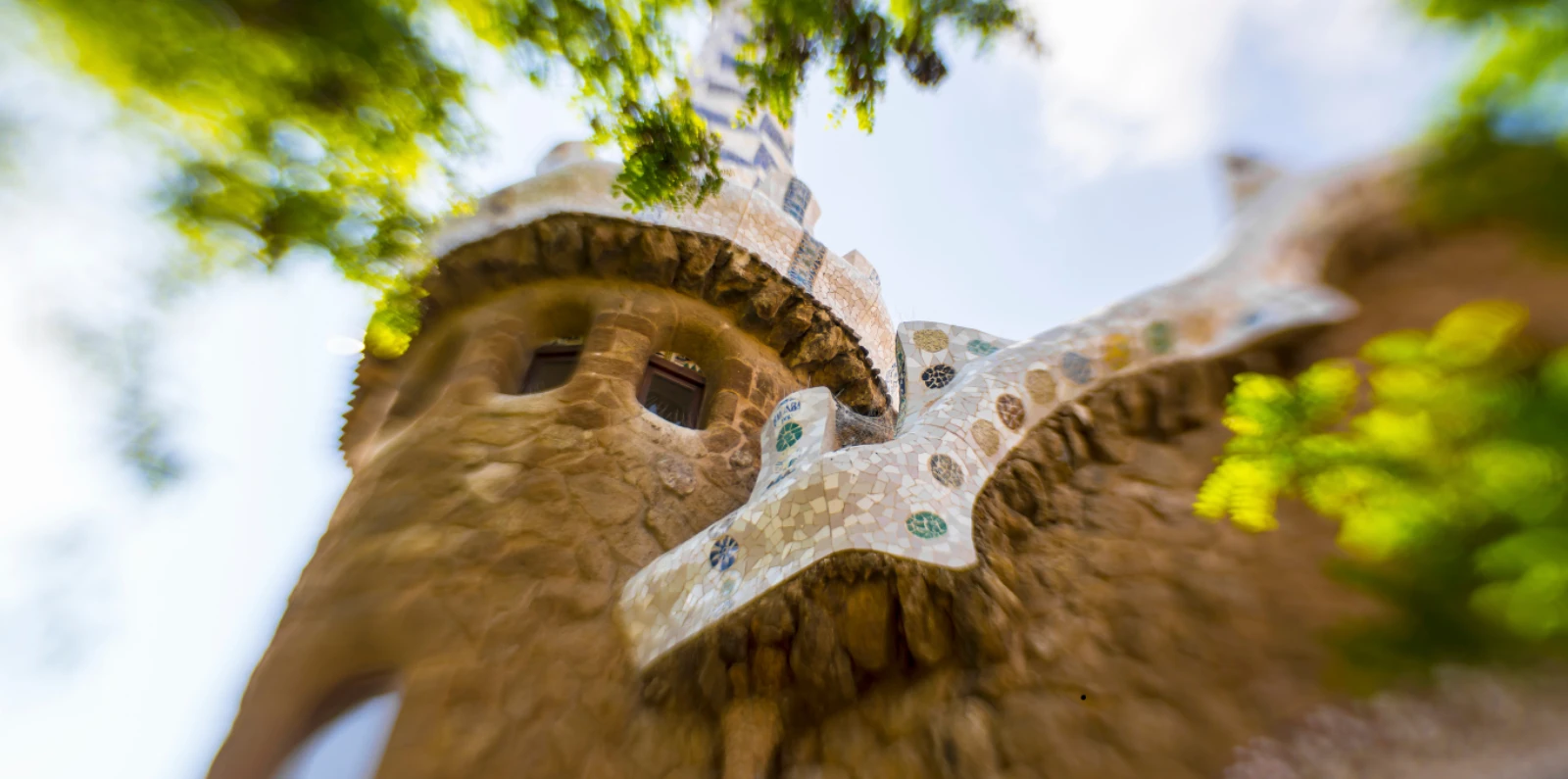

Gaudí designed a great church for a textile workers’ colony outside Barcelona, and then it stopped: only the lower nave was ever built, and in 1936 a fire took the rest of his plans. What survives, the Crypt at Colònia Güell, is the most important Gaudí building almost no one visits.
The church Gaudí never finished
The confusion starts with the name, and it has a reason. Gaudí designed the church in 1898, but the first stone was not laid until 4 October 1908. The full plan called for two naves, a lower and an upper one, crowned by side towers and a central dome 40 metres high. Gaudí himself described it as a monumental model of what the Sagrada Família would become.
It was never completed. In 1914 the Güell family stopped funding the work and Gaudí left the project, which was abandoned for good after Eusebi Güell’s death in 1918. Only the lower nave had been built, consecrated in 1915, and because just that base existed people began calling it the crypt. Of the monumental church Gaudí imagined, only the foundation remains, and that is what you visit today.
What is Colònia Güell and the Gaudí Crypt? Colònia Güell is a modernista textile workers’ colony in Santa Coloma de Cervelló, about 20 km from Barcelona, founded by Eusebi Güell in 1890. Its centrepiece is Gaudí’s Crypt, the only built part of an unfinished church that the architect used as a laboratory for the Sagrada Família. It is a UNESCO World Heritage Site, and only the crypt interior is ticketed; the rest of the colony is free to walk.
Key dates, from 1898 to 2005
The story spans a century, from a private commission to a world monument. This is the timeline at a glance.
| Year | Milestone |
|---|---|
| 1890 | Eusebi Güell starts the colony at Santa Coloma de Cervelló |
| 1898 | Gaudí designs the church |
| 1908 | The first stone is laid, on 4 October |
| 1915 | The lower nave is consecrated and becomes the crypt |
| 1936 | The crypt is burned in the Civil War and the original model is lost |
| 2005 | The site is listed as a UNESCO World Heritage Site |
For where this building sits in the architect’s wider work, the Gaudí route itinerary maps the rest, and the Sagrada Família guide shows where these ideas ended up.
The hanging model that engineered the Sagrada Família
This is the part that gets explained badly. To calculate an impossible structure without computers, Gaudí threw out conventional drawings and built an inverted 1:15 model in a shed beside the works. On a board fixed to the ceiling he drew the church’s floor plan, and from the points that would carry the building, columns and wall intersections, he hung cords weighted with little bags of lead shot. Suspended, those cords took the catenary curve on their own, for both arches and vaults. He then photographed the model and, by flipping the image upside down, read off the exact form of columns and arches, painting the final outline over the photographs.
The method was revolutionary because a catenary works purely in compression, so no buttresses or flying buttresses were needed, and walls could lean and curve into the landscape. Gaudí spent about 10 years on the study and applied the same system to the Sagrada Família. The original model was lost when the crypt was attacked and burned on 19 July 1936 during the Civil War; the reconstruction now shown at the Sagrada Família museum was rebuilt decades later from the surviving photographs.
Inside the crypt, leaning columns and cave light
Inside, there are almost no straight lines. Leaning basalt columns, brought from Castellfullit de la Roca, alternate with brick pillars and rise like tree trunks from the floor, while thin brick vaults trace the catenary Gaudí found with his model. Light filters softly through coloured glass and the space feels more like a cave than a church. Gaudí even planned the colour to blend the building into the landscape, starting the walls in dark, earthy tones low down.
The detail is all symbolism and reuse. Above the door, a ceramic mosaic gathers the 4 cardinal virtues and the 3 theological ones, and the windows repeat the Alpha and Omega in shapes of pine cones and inverted water drops to keep the rain out. There are three altars designed with Josep Maria Jujol, benches by Gaudí himself, and holy-water fonts made from giant marine shells brought from the Philippines. Even the window grilles were made from loom needles and waste brick from the factory, a recycling instinct also seen across the modernisme beyond Gaudí.
A whole modernista workers’ colony
The crypt is only one piece of a larger whole. Eusebi Güell began building Colònia Güell in 1890 to move his textile factory out of Sants to Santa Coloma de Cervelló and keep his workers away from the city’s social unrest. He raised a model village with housing, a school, a theatre, a cooperative and a hospital, today regarded as the best-preserved modernista industrial colony in Catalonia, with buildings by Gaudí’s collaborators Francesc Berenguer and Joan Rubió.
This changes how you visit. Only the crypt interior and the interpretation centre are ticketed; the rest is open village streets you walk for free. It pays to start at the interpretation centre, in the former cooperative, which explains the factory, working life and the architect’s innovations before you step into the crypt. It is industrial heritage that connects with the Palau Güell, another commission from the same patron, and rewards anyone who found Park Güell too crowded.
Visiting, hours, tickets and getting there
Getting there is quick and simple. FGC trains on lines S3, S4 and S8 leave from Plaça Espanya and stop at Colònia Güell in about 22 minutes; the station sits in Zone 1, so standard tickets cover it, and blue footprints painted on the pavement guide the 10-minute walk to the site. By car it is about 20 to 30 minutes with free parking. Opening hours are Monday to Friday from 10:00 to 17:00 and weekends and holidays from 10:00 to 15:00, closed on 1 and 6 January, Good Friday and 25 and 26 December.
On tickets, according to official data the general entry with audio guide is €10 and the reduced one €8, with under-10s free and the audio guide in 10 languages. According to experts, allow at least two hours to see the crypt and walk the colony, and expect a far quieter visit than Park Güell. To fit it into a wider plan, the train day trips guide and the budget and daily costs guide help line up the day.
Common questions about Colònia Güell
Why is Gaudí’s Crypt called a crypt if it is a church?
Because only the lower part was built. Gaudí’s design called for a church with two naves, side towers and a central dome 40 metres high, but the Güell family withdrew funding in 1914 and the work was abandoned after Eusebi Güell’s death. With only the lower nave standing, people began calling it the crypt.
What is Gaudí’s hanging string model?
An inverted 1:15 model with which Gaudí calculated the structure without drawings. He hung cords weighted with bags of lead shot from a ceiling board; suspended, they formed the catenary curves of arches and vaults. He photographed the model, and flipping the image upside down gave the exact form of columns and arches. He used the same method at the Sagrada Família.
How much does it cost to enter Colònia Güell?
According to official data, the general ticket with audio guide is €10 and the reduced one €8, for students, over-65s and large families. Under-10s enter free. Only the interior of Gaudí’s Crypt and the interpretation centre are ticketed; the rest of the colony is free to walk through along the village streets.
How do you get to Colònia Güell from Barcelona?
By FGC train from Plaça Espanya station, lines S3, S4 and S8, to the Colònia Güell stop, in about 22 minutes. It sits in Zone 1, so standard transport tickets cover it. From the station, blue footprints painted on the pavement guide the roughly 10-minute walk to the site.
Is Colònia Güell worth visiting?
Yes, especially if you are interested in Gaudí. It is calmer and far less crowded than Park Güell, with more historical context and the key to understanding how the architect thought. It lets you combine architecture, industrial heritage and the story of a modernista workers’ colony in a half-day trip.
The Sagrada Família is the finished work; the Crypt at Colònia Güell is the notebook where Gaudí worked out how to build it.