
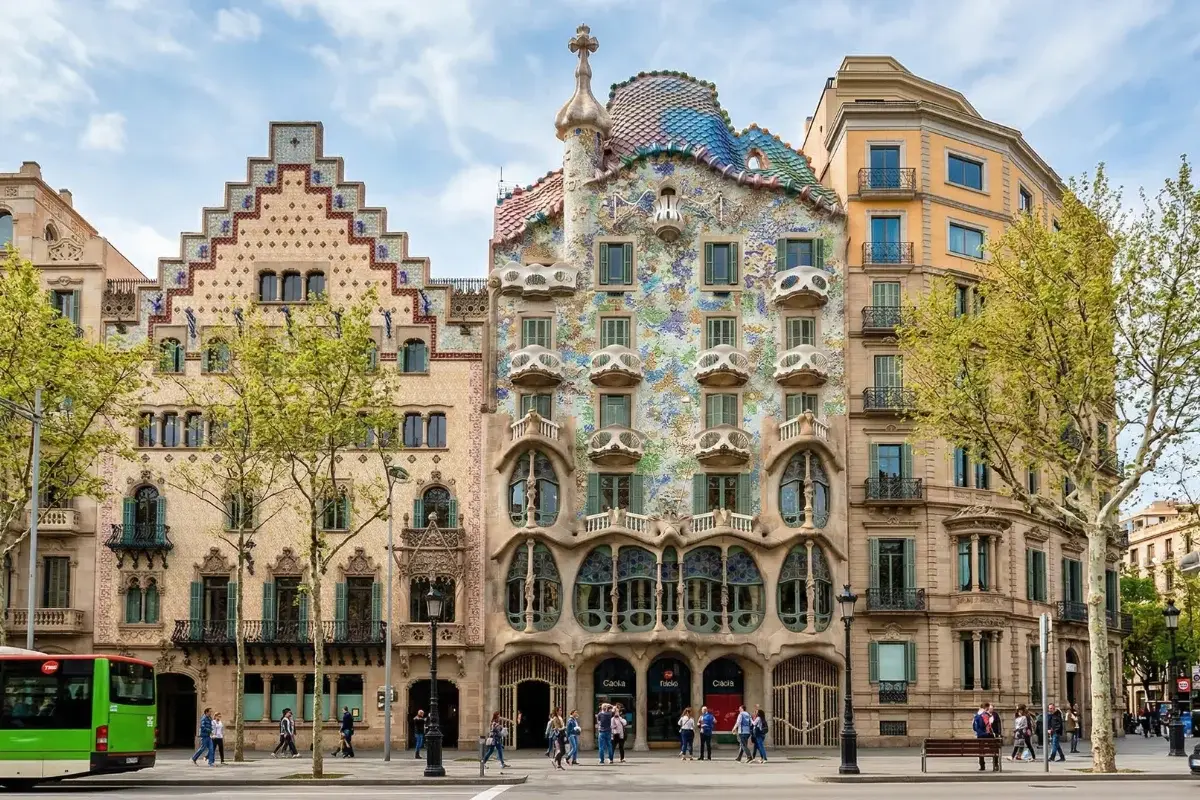

Barcelona packs a density of monumental architecture few European capitals can match, with over one hundred Modernista buildings and seven Gaudí works on the UNESCO World Heritage list. The demolition of the medieval walls in the mid-19th century and Cerdà’s 1860 grid plan — with its 113-metre blocks and chamfered corners — turned the city into a laboratory where the industrial bourgeoisie competed facade by facade. The clearest way to understand the result is not building by building but style by style: the 14th-century Gothic, the Modernista explosion around 1900, and the contemporary skyline all sit within five kilometres of each other. The single most-cited fact right now is that the Sagrada Família became the world’s tallest church in June 2026 at 172.5 metres — but it is one piece of a much larger picture, best seen alongside the essential things to see in Barcelona.
What Makes Barcelona’s Architecture Different
Most cities have a signature era. Barcelona has three that overlap in the same streets, and the reason is historical accident. The Gothic core was the medieval city; the Eixample grid gave the Modernista generation a blank canvas of identical plots where the only way to stand out was the facade; and the 1929 and 1992 expositions added monumental and contemporary layers. The competition between Gaudí, Domènech i Montaner and Puig i Cadafalch on a single block of Passeig de Gràcia — the Block of Discord — is the clearest expression of that facade rivalry, and it’s the reason a 20-minute walk crosses six centuries of building.
Gaudí’s Modernisme, the City’s Global Brand
Catalan Modernisme is the image Barcelona projects to the world, and Gaudí is its central figure. His buildings pair structural innovation — iron, concrete, self-supporting stone — with nature-inspired decoration, trencadís mosaic and heavy symbolism. The Eixample neighborhood holds the essentials within a walkable radius.
Sagrada Família — Gaudí’s masterpiece and the most famous building under construction in the world, begun in 1882. It has been a minor basilica since 7 November 2010, when Pope Benedict XVI consecrated it. Gaudí eliminated the Gothic flying buttresses he called “crutches” using tree-like columns that branch at angles to carry the vaults, creating a forest of stone. The interior floods with color through stained glass oriented to the time of day. It is UNESCO-listed and draws around 4.7 million visitors a year.
Casa Batlló (Passeig de Gràcia 43) — Gaudí’s 1904-1906 remodel of an 1877 building. The facade abandons the straight line entirely, clad in trencadís that shifts color with the light, with balconies like masks and a roof evoking the back of Sant Jordi’s dragon. Blue ticket from €30-35; the facade from the street is free. UNESCO-listed since 2005.
La Pedrera (Casa Milà) (Passeig de Gràcia 92) — built 1906-1912, it introduced a self-supporting limestone curtain wall, meaning the facade carries no structural load. That allowed open floor plans and elliptical light courts. Its rooftop, with sculptural warrior-like chimneys, is among the most photographed in the world. Entry is from €25.
Casa Vicens (Gràcia) — Gaudí’s first major work, 1883-1885, with green and yellow tiles and Oriental and Mudéjar influence. It’s the least crowded of his houses and the best place to see how he began. The full Gaudí route strings these works into one itinerary.
Modernisme Beyond Gaudí
Reducing Modernisme to Gaudí is a common mistake. Lluís Domènech i Montaner and Josep Puig i Cadafalch designed some of the most beautiful and technically advanced structures in Europe. Domènech i Montaner has two UNESCO World Heritage works, both listed in 1997.
Palau de la Música Catalana (Sant Pere) — a concert hall built 1905-1908 with a steel structure that allowed glass walls. Its inverted central skylight of stained glass, in gold and blue, floods the auditorium with daylight — unique among the world’s concert halls. The facade is free to see; the guided tour runs around €22.
Hospital de Sant Pau (Recinte Modernista) — the largest Modernista complex in Europe, by Domènech i Montaner, 1902-1930. Conceived as a garden-city hospital with 12 pavilions linked by a kilometre of underground tunnels, it used beauty as a therapeutic tool. The exterior and gardens are free; interior entry is around €16. It sits a short walk from the Sagrada Família along Avinguda de Gaudí.
Casa Amatller (Passeig de Gràcia 41) — by Puig i Cadafalch, sharing the Block of Discord with Casa Batlló. Its stepped gable evokes Flemish townhouses and mixes neo-Gothic with ceramic. It was home to the Amatller chocolate-making family.
Catalan Gothic, the City’s Foundations
Before Modernisme, Catalan Gothic had defined a style of its own — horizontality, restraint, and large open interiors. The old town holds some of the most harmonious Gothic ensembles in Europe, nearly all free or very cheap to enter. Anyone walking the Gothic Quarter finds them within minutes.
Santa Maria del Mar (Born) — the purest example of Catalan Gothic, raised between 1329 and 1383. Its stylistic unity is exceptional because it went up in only 54 years, funded by the neighborhood’s maritime community. Three naves of equal height with octagonal columns spaced about 13 metres apart create the airy light that earned it the nickname “cathedral of the sea.”
Barcelona Cathedral (Barri Gòtic) — dedicated to Santa Eulàlia, built mainly between the 13th and 15th centuries with a 19th-century neo-Gothic facade. Its cloister keeps 13 white geese symbolizing the saint’s age at martyrdom. The rooftop offers views over the old town.
Monestir de Pedralbes — a Poor Clares monastery founded in 1327, with an exceptionally preserved three-storey Gothic cloister. It’s one of the quietest, most light-filled corners of the city, far from the crowded center.
Monumental and Contemporary
Barcelona didn’t stop in 1910. The 1929 exposition and the 1992 Olympics left landmarks that reshaped the skyline, adding a contemporary layer worth photographing.
Palau Nacional / MNAC (Montjuïc) — a 1929 historicist palace dominating Plaça d’Espanya, home to the MNAC collection. Its steps and terrace give one of the best free panoramas in the city, chained with the Magic Fountain below.
Mies van der Rohe Pavilion (Montjuïc) — the manifesto of the Modern Movement, built for the 1929 exposition. Marble, chromed steel, glass and an open plan defined the International Style from here. Small, spare, and a quick visit.
Torre Glòries (Plaça de les Glòries) — Jean Nouvel’s 144-metre tower, built 1999-2005, with a glass skin and over 4,500 LED fixtures that generate endless color combinations at night. Since 2022 it has a 360º viewing deck at 125 metres with views over the Eixample, the Sagrada Família and the sea.
W Barcelona (Hotel Vela) — Ricardo Bofill’s sail-shaped tower, opened in 2009 facing Barceloneta, nearly 99 metres of curved glass reflecting the sea. It has become the icon of the waterfront.
Comparison Table of the Essentials
| Building | Style | Era | What sets it apart |
|---|---|---|---|
| Sagrada Família | Modernisme | From 1882 | World’s tallest church, 172.5 m |
| Casa Batlló | Modernisme | 1904-1906 | Trencadís facade, no straight lines |
| La Pedrera | Modernisme | 1906-1912 | Self-supporting stone wall, sculptural roof |
| Palau de la Música | Modernisme | 1905-1908 | Inverted stained-glass skylight |
| Hospital de Sant Pau | Modernisme | 1902-1930 | Largest Modernista complex in Europe |
| Santa Maria del Mar | Catalan Gothic | 1329-1383 | Stylistic unity in 54 years |
| Torre Glòries | Contemporary | 1999-2005 | 144 m, LED facade, 360º deck |
2026 Context, the Gaudí Centenary
On 10 June 2026, marking the centenary of Gaudí’s death, Pope Leo XIV inaugurated the Sagrada Família’s Tower of Jesus Christ. At 172.5 metres, the temple has since been the tallest church in the world and the tallest building in Barcelona, ahead of the Torre Glòries. The 17-metre cross crowning it was installed in February 2026, having already overtaken Germany’s Ulm Minster in October 2025. The building remains under non-structural work, but its definitive silhouette is complete — making 2026 the best year yet to see it.
The Essential Three If You’re Short on Time
With only a day, three works capture the city’s architectural soul: the Sagrada Família for Gaudí’s structural vision, Casa Batlló for fantasy turned into a facade, and the Palau de la Música for Modernisme at its most elegant. All three are booked online in advance — especially the Sagrada Família, whose tower access sells out days ahead in high season. To fit them around the rest of a trip, the first-time visitor guide places each one in the context of the wider city.
Beauty and height rarely coincide here, and in 2026 the tallest building in Barcelona changed for the first time in over three decades, as the skyline guide records.
Frequently Asked Questions
What is the tallest building in Barcelona?
Since June 2026 it is the Sagrada Família, which with the Tower of Jesus Christ reaches 172.5 metres and became the tallest church in the world. Gaudí’s design deliberately stays below Montjuïc’s 177 metres. The tallest civil building remains the Torre Glòries at 144 metres.
How many Modernista buildings are there in Barcelona?
Barcelona has over one hundred Modernista buildings, the highest concentration of the movement anywhere. The official Ruta del Modernisme catalogues more than 115 sites. Gaudí’s work alone accounts for seven UNESCO World Heritage listings across the Eixample, Gràcia and Park Güell.
Which famous Barcelona buildings can you see for free from outside?
The facades of Casa Batlló, Casa Amatller and Casa Lleó Morera on the Block of Discord are free to view from Passeig de Gràcia. So are the exterior and gardens of Hospital de Sant Pau, the Palau de la Música facade, and the nightly LED-lit silhouette of the Torre Glòries.
What is the best example of Catalan Gothic in Barcelona?
Santa Maria del Mar in El Born, built between 1329 and 1383. Its stylistic unity is exceptional because it went up in just 54 years. Three naves of equal height with columns spaced around 13 metres apart create a sense of space and light rare in European Gothic.
In what order should you visit Gaudí’s houses?
Gaudí’s own evolution makes chronological order the logical choice: Casa Vicens (1883-1885), his first major work; Casa Batlló (1904-1906), his most creative remodel; and La Pedrera (1906-1912), the culmination with a self-supporting stone facade. All three are UNESCO-listed.
Is the Sagrada Família finished now that the central tower is complete?
Not entirely. The Tower of Jesus Christ was inaugurated in June 2026, completing the building’s final 172.5-metre silhouette, but non-structural work continues. The full set of 18 towers is in place, so the profile is now definitive even as detailing carries on.
Barcelona’s beauty isn’t any single building — it’s the short distance separating seven centuries of architecture that learned to live face to face.